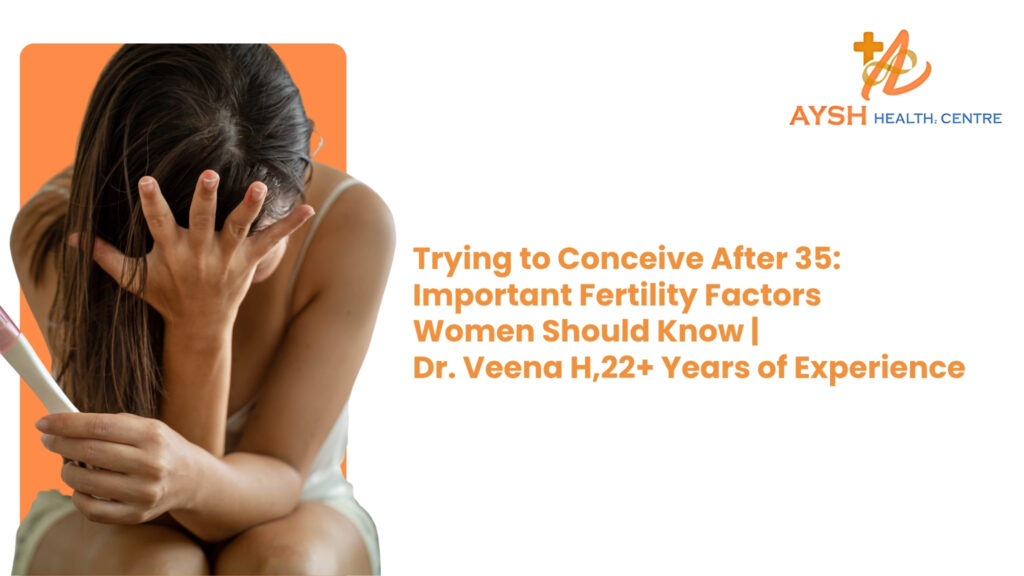
Trying to conceive after 35 can bring many questions. You may wonder whether age affects fertility, how long you should try naturally, when to seek a fertility evaluation, and what steps can support a healthy pregnancy.
While many women conceive naturally after 35, fertility does change with age. Understanding these changes and seeking timely medical guidance can help women make informed decisions about pregnancy planning.
If you are looking for a gynecologist in Bangalore for pregnancy planning or fertility-related concerns, a consultation can help you understand your individual reproductive health. At Aysh Healthcare, Dr. Veena H has more than 22 years of experience in gynecology and provides care related to women’s health, pregnancy, PCOS, menstrual concerns, and pregnancy planning. (ayshhealthcare.com)
Does Fertility Decline After 35?
Yes, female fertility generally declines with age, although the rate of change differs from woman to woman.
Women are born with a finite number of eggs. As age increases, both the number and quality of available eggs tend to decline. This can make conception take longer and may increase the risk of certain pregnancy complications.
However, 35 is not a sudden biological deadline. Many women become pregnant naturally in their late 30s and beyond.
The important consideration is that age can influence how long you should wait before seeking professional advice if pregnancy doesn’t occur.
Why Can It Take Longer to Conceive After 35?
Several fertility factors can become more relevant with increasing age.
These include:
- Declining ovarian reserve
- Changes in egg quality
- Changes in ovulation
- Increased likelihood of certain gynecological conditions
- Male-factor fertility issues
- Changes in the uterus or fallopian tubes
- Existing medical conditions
Not every woman will experience these issues, which is why personalized evaluation is important.
Egg Quantity and Egg Quality After 35
One of the major age-related fertility factors is the change in ovarian reserve.
Ovarian reserve refers broadly to the number of eggs remaining in the ovaries.
As women age, ovarian reserve generally decreases. Egg quality can also decline, which may affect the ability of an egg to fertilize and develop normally.
This doesn’t mean that pregnancy after 35 is unlikely. It means that time can become a more important consideration when planning pregnancy.
What Is Ovarian Reserve?
Ovarian reserve is an indication of the remaining egg supply.
Doctors may use different assessments when evaluating ovarian reserve, depending on the individual’s situation.
These may include:
- Medical and reproductive history
- Ultrasound assessment
- Certain hormone tests
However, ovarian-reserve testing does not provide a simple yes-or-no answer about whether someone can become pregnant naturally.
Your doctor needs to interpret these findings alongside age, menstrual history, partner factors, and other fertility information.
Does Ovulation Change After 35?
Some women continue to ovulate regularly throughout their late 30s.
Others may experience changes in cycle regularity or ovulation.
If your periods are irregular, very short, unusually long, or absent, it is worth discussing them with a gynecologist in Attiguppe.
Irregular cycles can sometimes indicate ovulation problems, including those associated with conditions such as PCOS.
How Long Should You Try Naturally After 35?
Age can influence when it is appropriate to seek a fertility evaluation.
For women aged 35 or older, professional guidance commonly recommends considering an infertility evaluation after six months of regular, unprotected intercourse without conception.
Women over 40 may benefit from seeking advice sooner rather than waiting six months.
You may also want to consult a doctor earlier if you have:
- Irregular periods
- Known PCOS
- Endometriosis
- Previous pelvic surgery
- Previous fertility problems
- Recurrent pregnancy loss
- Known reproductive conditions
The purpose of an evaluation isn’t necessarily to start fertility treatment immediately. It is to understand whether any factors may be affecting conception.
What Fertility Factors Should Women Over 35 Consider?
1. Menstrual Cycle Regularity
Your menstrual cycle can provide useful information about reproductive health.
Regular cycles often suggest regular ovulation, although they don’t guarantee that every fertility factor is normal.
If your cycles are unpredictable, discussing them with your doctor can help determine whether further evaluation is appropriate.
2. Ovarian Reserve
Ovarian reserve can become an increasingly important consideration with age.
Your doctor may recommend certain tests if there is a reason to assess ovarian reserve.
3. Egg Quality
Age is strongly associated with changes in egg quality.
Egg quality is one reason fertility tends to decline as women get older.
4. Fallopian-Tube Health
The fallopian tubes provide the pathway through which the egg and sperm meet.
Certain infections, surgeries, endometriosis, or other conditions can affect the tubes.
5. Uterine Health
Conditions such as fibroids, polyps, or other structural changes may affect fertility or pregnancy in some women.
6. Male-Factor Fertility
Fertility is not solely a woman’s concern.
Sperm count, movement, and morphology can affect the chances of conception, so fertility evaluation may involve both partners.
Does Having Regular Periods Mean You Can Get Pregnant Easily?
Not necessarily.
Regular periods can be a reassuring sign that ovulation may be occurring, but conception requires several factors to work together.
These include:
- Ovulation
- Egg quality
- Sperm health
- Open fallopian tubes
- Healthy uterine conditions
- Appropriate timing
- Successful fertilization and implantation
Therefore, if pregnancy isn’t occurring despite regular cycles, a fertility evaluation may still be appropriate.
What Are the Signs You Should See a Gynecologist?
Women trying to conceive after 35 should consider speaking with a doctor if they experience:
Irregular periods: This may indicate inconsistent ovulation.
Very painful periods: Severe menstrual pain can sometimes be associated with conditions such as endometriosis.
Previous pelvic surgery: Certain procedures can affect reproductive anatomy.
Previous pregnancy loss: Recurrent pregnancy loss warrants medical evaluation.
Known PCOS: PCOS can affect ovulation in some women.
Previous fertility treatment: A history of fertility difficulties may justify earlier assessment.
No pregnancy after six months: For women aged 35 or older, this is an important point at which to consider evaluation.
Can PCOS Affect Fertility After 35?
PCOS can affect ovulation and therefore make conception more difficult for some women.
Women with PCOS may experience:
- Irregular periods
- Infrequent ovulation
- Acne
- Increased facial or body hair
- Metabolic concerns
However, having PCOS doesn’t mean pregnancy is impossible.
If you have PCOS and are planning pregnancy, appropriate evaluation and management can help determine whether you are ovulating regularly and whether additional care is needed.
What About Endometriosis?
Endometriosis is another condition that can be relevant when evaluating fertility.
Some women with endometriosis experience:
- Painful periods
- Pelvic pain
- Pain during intercourse
- Difficulty conceiving
Not every woman with endometriosis will experience fertility problems, but if you have symptoms or a known diagnosis and are planning pregnancy, discussing your reproductive goals with a gynecologist can be helpful.
What Tests May Be Recommended?
There isn’t one fertility test that can determine everything about your ability to conceive.
Depending on your history, your doctor may recommend:
Blood Tests
Certain hormone tests may be used to assess reproductive function or other health factors.
Pelvic Ultrasound
Ultrasound can help evaluate the uterus and ovaries and identify certain structural conditions.
Ovulation Assessment
Your doctor may assess whether you are ovulating regularly.
Tubal Evaluation
In selected cases, testing may be recommended to determine whether the fallopian tubes are open.
Semen Analysis
A semen analysis can evaluate male reproductive factors.
The specific investigations should be personalized rather than performed automatically in every patient.
Can You Improve Fertility After 35?
You cannot reverse the natural effects of reproductive aging, but healthy habits can support overall reproductive and pregnancy health.
Maintain a Healthy Weight
Both being significantly underweight and overweight can affect reproductive health.
Eat a Balanced Diet
Focus on a varied diet containing vegetables, fruits, whole grains, protein sources, and healthy fats.
Avoid Smoking
Smoking can negatively affect fertility and pregnancy health.
Limit Alcohol
When planning pregnancy, reducing or avoiding alcohol is generally advisable.
Exercise Regularly
Moderate physical activity can support general health.
Manage Medical Conditions
Conditions such as diabetes, thyroid disorders, hypertension, and PCOS should be appropriately managed before pregnancy.
Take Folic Acid
Women planning pregnancy are generally advised to take folic acid before conception. Your doctor can recommend the appropriate dosage based on your individual circumstances.
Is Pregnancy After 35 High Risk?
Pregnancy after 35 is not automatically a high-risk pregnancy.
However, certain pregnancy-related risks can become more common with increasing maternal age.
These may include an increased likelihood of:
- Gestational diabetes
- High blood pressure during pregnancy
- Chromosomal abnormalities
- Miscarriage
- Certain pregnancy complications
This is one reason pregnancy care after 35 may involve closer monitoring depending on the woman’s health and pregnancy history.
Your doctor can explain which screening and monitoring options are appropriate for you.
Does Age Affect Miscarriage Risk?
The risk of miscarriage increases with maternal age, with chromosomal abnormalities being one contributing factor.
However, an increased statistical risk doesn’t mean that an individual pregnancy will necessarily have a negative outcome.
If you have experienced pregnancy loss, discussing your medical history with an experienced gynecologist can help determine whether further evaluation is appropriate.
Can Women Over 35 Conceive Naturally?
Yes.
Many women conceive naturally after 35.
Age is one factor among many that influence fertility. Some women in their late 30s conceive without fertility treatment, while others may require medical assistance.
The important point is to avoid comparing your fertility journey with someone else’s.
If pregnancy is taking longer than expected, timely evaluation can help identify possible factors.
Should Men Also Be Evaluated?
Yes.
Male factors can contribute significantly to difficulty conceiving.
A fertility evaluation may therefore include the male partner, particularly when pregnancy has not occurred despite regular attempts.
A semen analysis is a relatively straightforward investigation that can provide useful information about sperm count, movement, and morphology.
Why Is Timing Important After 35?
One of the most important reasons for seeking timely advice is that fertility can continue to change with age.
Waiting several years before seeking evaluation may reduce the available time for identifying and addressing fertility-related factors.
This doesn’t mean you should become anxious if pregnancy doesn’t happen immediately.
It means that women over 35 may benefit from earlier professional guidance when conception is taking longer than expected.
How Can Dr. Veena H Help With Pregnancy Planning?
If you’re looking for a gynecologist in Bangalore for pregnancy planning, menstrual concerns, PCOS, or reproductive-health questions, a consultation can provide an opportunity to discuss your medical history and pregnancy goals.
Dr. Veena H has more than 22 years of experience in gynecology. Aysh Healthcare’s published information highlights her work in women’s health, pregnancy care, PCOS, menstrual problems, and pregnancy-related guidance. (ayshhealthcare.com)
A consultation can help you understand:
- Your menstrual and reproductive history
- Potential fertility factors
- Whether testing is appropriate
- Preconception health considerations
- When specialist fertility care may be needed
Why Choose Aysh Healthcare?
When selecting the best gynecologist in Attiguppe for pregnancy planning, experience and individualized care are important.
Aysh Healthcare provides women’s healthcare services, and Dr. Veena H’s profile highlights more than 22 years of experience in gynecology. (ayshhealthcare.com)
For women trying to conceive after 35, a personalized consultation can help put age-related fertility changes into perspective and determine whether additional evaluation is appropriate.
Frequently Asked Questions About Trying to Conceive After 35
Is 35 too late to have a baby?
No. Many women have healthy pregnancies after 35. However, fertility generally declines with age, so women may benefit from seeking medical advice sooner if conception takes longer than expected.
How long should I try to conceive after 35 before seeing a doctor?
Women aged 35 and older are generally advised to consider a fertility evaluation after six months of trying without conception. Earlier consultation may be appropriate if there are known fertility concerns.
Does fertility suddenly decline at 35?
No. Fertility doesn’t suddenly stop at 35. The decline is gradual, although it becomes increasingly important as women approach their late 30s and 40s.
Can I get pregnant naturally after 35?
Yes. Many women conceive naturally after 35. Individual fertility varies considerably.
What fertility tests are recommended after 35?
Depending on your history, your doctor may recommend ovulation assessment, blood tests, ultrasound, ovarian-reserve assessment, tubal evaluation, and semen analysis for the male partner.
Does PCOS make pregnancy harder after 35?
PCOS can affect ovulation and may make conception more difficult for some women. Appropriate management can help address ovulation-related concerns.
Should I see a gynecologist before trying to conceive after 35?
A preconception consultation can be useful, particularly if you have existing medical conditions, take medications, have irregular cycles, or have concerns about your reproductive health.
Conclusion
Trying to conceive after 35 can be a rewarding journey, but age-related fertility changes make it particularly important to understand your reproductive health and know when to seek professional guidance.
Egg quantity and quality, ovulation, fallopian-tube health, uterine conditions, male-factor fertility, PCOS, endometriosis, and overall health can all influence conception.
If you are 35 or older and have been trying to conceive for six months without success, consider discussing a fertility evaluation with a qualified doctor. Women over 40 or those with known fertility concerns may benefit from seeking advice even sooner.
At Aysh Healthcare, Dr. Veena H brings more than 22 years of gynecological experience and provides women’s healthcare and pregnancy-related care in Bangalore. (ayshhealthcare.com)
If you’re planning pregnancy after 35 and want to understand your individual fertility factors, consider scheduling a consultation with Dr. Veena H at Aysh Healthcare.
Aysh Healthcare
Bangalore
Website: ayshhealthcare.com